Your child wakes up with a sore throat and a fever. Your back twinges as you lift a box at work. A rash shows up on your arm after a weekend of yard work.
In each moment, the same question comes up: is this an ER trip, an urgent care visit, or something that can wait?
Most people make that call alone, with a search engine and a little guesswork. That guesswork can cost you an expensive emergency room bill for something minor, or worse, a delay for something serious.
This guide maps common situations to the right level of care. It also explains how having your own Direct Primary Care provider changes the decision, because for many acute concerns, your best first step is a quick message to someone who already knows you.
If you think you or someone with you is having a life-threatening emergency, call 911 now. Don’t read further, and don’t message us first.
The 4 Levels of Care, in Plain Terms
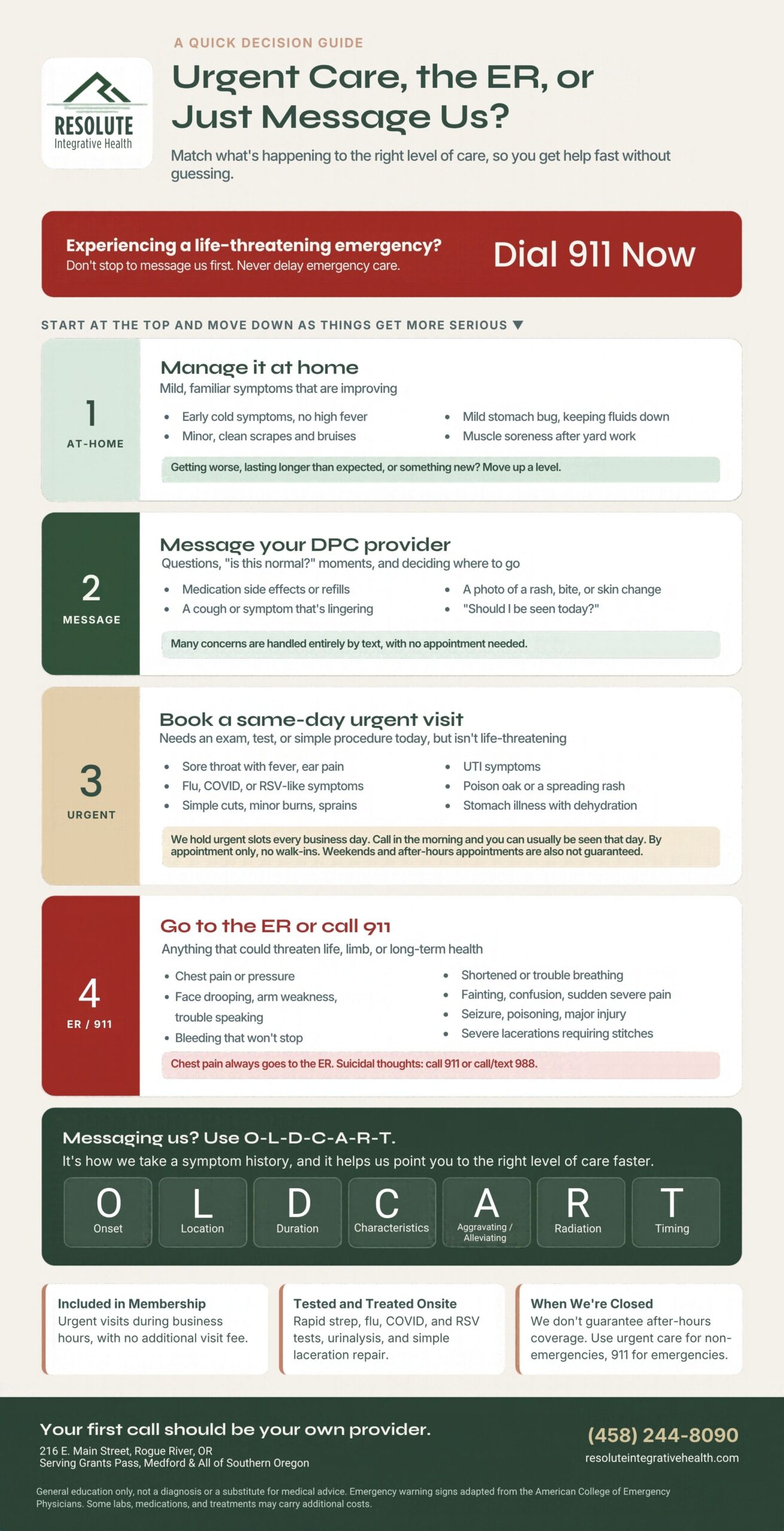
Before getting to examples, it helps to see the full ladder. Most health concerns fit into one of four levels.
- Manage it at home. Many everyday illnesses are self-limited, which means they run their course with rest, fluids, and over-the-counter comfort care without the need to involve your medical team.
- Message your DPC provider. For questions, “is this normal?” moments, and deciding whether you need to be seen. Many concerns are handled entirely by text, with no appointment.
- Get an urgent visit. For problems that need an exam, a rapid test, or a simple procedure today, but are not life-threatening; often these can be managed by your DPC provider.
- Go to the ER or call 911. For anything that could threaten your life, a limb, or your long-term health if care is delayed.
Share This Infographic on Your Website
Help others understand when to visit the ER, urgent care, or direct primary care. You’re welcome to feature this infographic on your website, blog, or resource page!
Simply copy the embed code below. It includes the infographic and a link to the original resource at Resolute Integrative Health.
Let’s start at the top of the ladder, because this is the part that matters most. Emergency departments exist for situations where minutes count, and no primary care office, including ours, is a substitute for one.
The American College of Emergency Physicians lists warning signs of a medical emergency that include:
- Difficulty breathing or shortness of breath
- Chest or upper abdominal pain or pressure lasting two minutes or more
- Fainting, sudden dizziness, or weakness
- Changes in vision or difficulty speaking
- Confusion, unusual behavior, or difficulty waking
- Any sudden or severe pain
- Uncontrolled bleeding
- Severe or persistent vomiting or diarrhea
- Coughing or vomiting blood
- Suicidal or homicidal feelings (Call 988 or visit 988lifeline.org)1
ACEP’s guidance on urgent versus emergent care adds facial drooping or weakness in an arm or leg, allergic reactions, head trauma, seizures, poisoning, major broken bones, and bleeding that doesn’t stop after 10 minutes.
For children, the same ACEP guide points to signs like decreasing responsiveness, unusual sleepiness, skin or lips that look blue or gray, abnormal or difficult breathing, and a severe headache or repeated vomiting after a head injury.2
A few practical notes:
- Call 911 rather than driving when the condition could worsen on the way, when moving the person could cause injury, or when you’re unsure. Paramedics can begin treatment before you reach the hospital.
- Chest pain always belongs in the ER. We do have an EKG in our clinic, but we never use it to evaluate chest pain. That evaluation needs an emergency department.
- Don’t stop at an urgent care center for a serious problem. If you go to an urgent care center with a serious illness or injury, you’ll be sent on to the emergency department, which delays your care.
No list covers every emergency. If your instincts say something is seriously wrong, trust them and go.
When to Go to Urgent Care Instead of the ER
Urgent care sits in the middle. It’s the right level for problems that need attention today but are not life-threatening: an infection that needs a test, a minor injury, or an illness that’s getting worse instead of better.
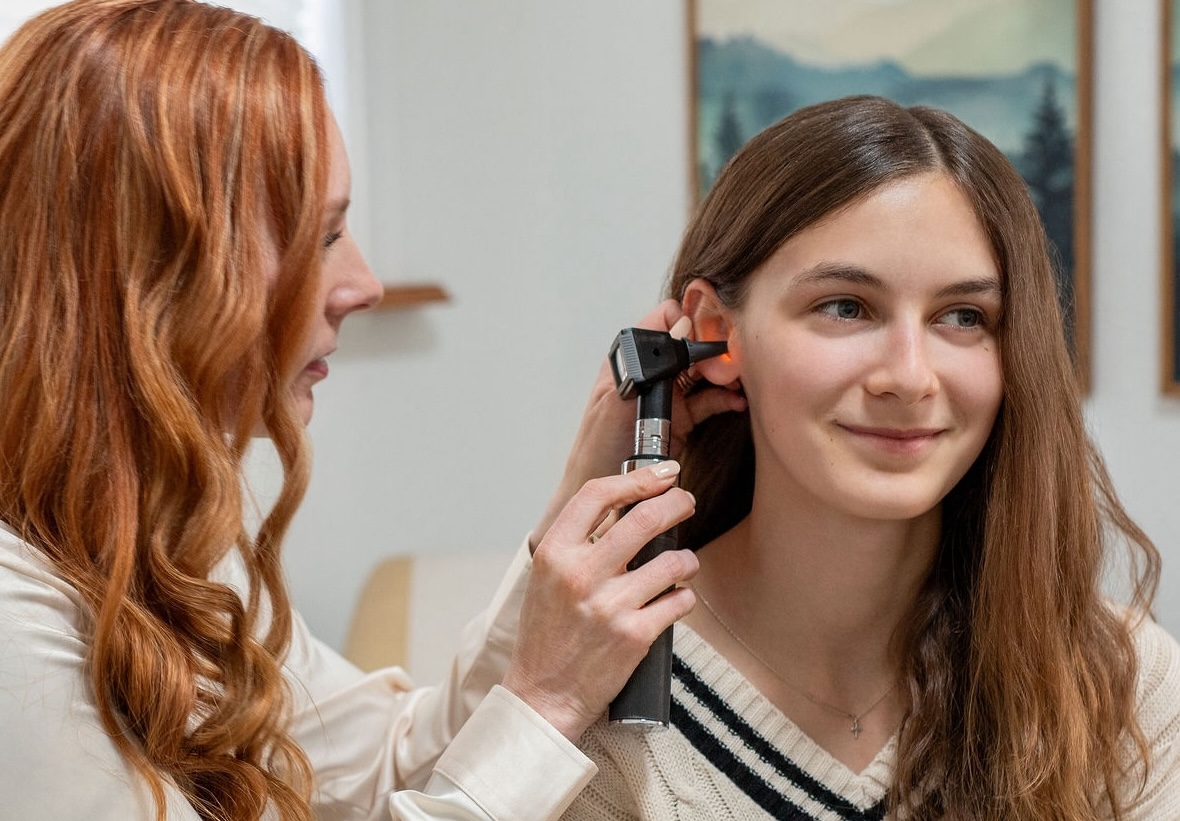
Choosing correctly matters for your wallet, too. A recent study of national insurance claims found that by 2019, emergency department visits for lower-acuity problems were roughly ten times more expensive than urgent care center visits. An ER bill for a sore throat is a hard way to learn that lesson.3
For our members, “urgent care” usually means an urgent visit with us. We reserve urgent care slots on our schedule every business day, and members who call in the morning can usually be seen that same day. Our urgent care in Rogue River handles the kinds of concerns people often take to a walk-in clinic, including:
- Sudden illness or infection, including cold, flu, sinus, and respiratory symptoms
- Sore throats and ear infections
- Urinary tract infection symptoms
- Poison oak, rashes, and mild allergic reactions
- Minor injuries, such as cuts, scrapes, and first-degree burns
- Minor stomach illness or dehydration concerns
- Mild fevers or symptoms that won’t go away
Because we can test and treat onsite, many urgent visits are resolved in one trip. Our in-house capabilities include:
- Rapid testing for RSV, COVID, flu, and strep
- Hemoglobin, urinalysis, and wet mount testing
- Select acute medications, such as anti-nausea medication, antibiotics, and Toradol
- Nebulized breathing treatments
- Simple wound care and simple laceration repair
- Occasional IV hydration when it’s medically needed for dehydration
Two details are important. First, urgent care with us is by appointment only, with no walk-ins, so reach out before you head our way. Second, urgent visits happen during business hours. We don’t guarantee after-hours coverage, and in-house care on weekends or after hours is not routinely offered and carries an additional fee. If an urgent but non-emergency problem comes up while we’re closed, a local urgent care center is a reasonable choice. For emergencies, the answer is always 911 or the ER.
When to Just Message Your DPC Provider
This is the level most people don’t know they have. In a traditional system, a question often turns into an appointment, and an appointment that’s two weeks out turns into an urgent care trip. With Direct Primary Care, you can simply ask.
A quick message works well for:
- “Is this normal?” questions after a new medication, a recent visit, or a symptom that’s lingering
- Medication refills and side effects, since we already have your medication list
- A photo of a rash, bite, or skin change, so we can decide together how soon it should be seen
- Symptoms that started recently and that you’re unsure about
- Deciding where to go, whether that’s home care, an urgent visit with us, or the ER
When you text us, we do our best to respond promptly, and many concerns are handled entirely by text with no appointment. Whether you need to come in depends on what you’re experiencing and what you tell us. Sometimes the answer is a same-day visit. Sometimes it’s a virtual check-in. And often, the best answer is reassurance and a plan for care at home.
That last outcome isn’t a brush-off. Many minor infections and everyday illnesses get better on their own, and they don’t need a prescription or a visit. Antibiotics, for example, are often overprescribed for respiratory infections. More prescribing isn’t better care; appropriate prescribing is. Getting a clear “you can manage this at home, and here’s what to watch for” from a provider who knows you is a good result.
If you’d like a closer look at what can be handled remotely, our guide to telemedicine urgent care walks through which concerns work well by call or message and which ones need an exam.
When It’s Safe to Manage Symptoms at Home
Plenty of health concerns need nothing more than time, rest, and good home care. In general, home care is a reasonable starting point when symptoms are mild, familiar to you, and improving rather than getting worse. Examples include:
- Early cold symptoms, such as a runny nose or a scratchy throat without a high fever
- A mild stomach bug when you’re able to keep fluids down
- Minor scrapes and bruises that are clean and not deep
- Mild muscle soreness after yard work or exercise
- A typical headache that feels like headaches you’ve had before
Home care works best with a plan for what would change your mind. Reach out to us if symptoms last longer than expected, get worse instead of better, or if something new appears. And skip straight to the ER for any of the warning signs above.
When Your First Call Should Be Your Own Provider
When you walk into an urgent care center, or an ER in non-emergency situations, you start from zero. You recite your history, list your medications from memory, and see someone who has never met you. They do their best with the information you give them at the moment.
When you message us, the conversation starts with your full history already in view. As our urgent care page puts it, because we already know your health history, we can provide faster, more accurate care, which reduces guesswork and helps you get the right treatment without unnecessary delays.
That continuity changes the decision itself:
- Fewer guesses. We know whether this rash looks like the one you had last spring, or whether your blood pressure history changes how we read a new symptom.
- Faster routing. If you need the ER, we’ll tell you plainly. If you don’t, you may avoid a long wait and a large bill.
- Better follow-up. After any visit, including an ER visit, we can help you make sense of results and next steps.
Isn’t an urgent care membership the same thing?
Not quite. While some urgent care centers offer membership programs, they’re relatively uncommon and typically focus on access to urgent, short-term care rather than an ongoing relationship with a provider. A recent study found that just 6% of 250 urgent care centers surveyed offered memberships. Even with a membership, patients may face additional fees for imaging and lab services, and continuity of care can remain limited.4
Direct Primary Care is different because the ongoing relationship is the foundation of your care.
You see the same provider for routine visits, chronic conditions, preventive care, and urgent concerns. That means the person helping with your sore throat already knows your medical history, medications, and long-term health goals. You’re not just paying for access when something goes wrong; you’re investing in consistent, personalized care from someone who knows your whole health story.
What to Tell Us When You Reach Out
The more specific you are, the faster we can help you decide on the right level of care. We take symptom histories using a framework called O-L-D-C-A-R-T, and you can use it to organize your message:
| Letter | What it means | Example |
| O | Onset | “It started yesterday morning.” |
| L | Location | “Right ear, not the left.” |
| D | Duration | “It comes and goes, about an hour each time.” |
| C | Characteristics | “Dull ache, not sharp.” |
| A | Aggravating or alleviating factors | “Worse lying down, better with ibuprofen.” |
| R | Radiation | “It doesn’t spread anywhere.” |
| T | Timing | “Worst in the morning.” |
It also helps to mention any fever and its reading, any medications you’ve already taken, and whether symptoms are improving, staying the same, or getting worse.
A clear photo sent via text is also useful for anything you can easily see, such as a rash or a cut.
What Urgent Care Costs With Our Membership
Urgent care visits are included in your membership, with no additional visit fees for appointments during business hours. That removes one of the biggest reasons people wait too long to get checked out: worrying about the bill.
A few things to know:
- Some items may cost extra. Certain labs, cultures, medications, and specialized treatments may carry additional costs.
- Keep your insurance. Our membership covers primary care in our clinic. Health insurance is still important for emergency room visits, hospital stays, imaging, specialists, and outside testing.
- Appointments are required. If you are a current patient, reach out by phone, text, or through our Patient Hub, which runs on Elation, and we’ll get you scheduled.
For current membership pricing, visit our membership page and confirm details with our team, since pricing can change.

Frequently Asked Questions
How do I know when to go to urgent care vs the ER?
Go to the ER or call 911 for anything that could threaten life or limb, such as chest pain, trouble breathing, stroke signs, severe pain, or heavy bleeding. Choose urgent care for problems that need attention today but aren’t life-threatening, like a sore throat with fever, ear pain, or a minor cut. If you’re a member and unsure, message us during business hours and we’ll help you decide.
Can Resolute treat emergencies?
No. We’re a primary care practice with urgent access, not an emergency department. For any emergency, call 911 or go to the nearest ER.
Can I walk in to Resolute for urgent care?
No. Urgent care is by appointment only, with no walk-ins. Members who call in the morning can usually be seen the same day, because we reserve urgent slots every business day.
What if something urgent happens when you’re closed?
We don’t guarantee after-hours or weekend coverage. If you have an urgent, non-emergency problem while we’re closed, a local urgent care center is a reasonable option. For emergencies, call 911 or go to the ER.
Do I need an appointment for every new symptom?
Not always. Whether a symptom needs an in-person exam depends on what you’re experiencing and what you tell us. Many concerns are handled by text, and some are best managed at home with a clear plan.
When to Talk to a Provider
If you’ve ever stood in your kitchen trying to decide between waiting it out and driving to the ER, you already know the value of having someone to ask. These are signs a Direct Primary Care membership may be worth exploring:
- You’ve used the ER or urgent care for problems your own provider could have handled.
- You’ve delayed care because the next appointment was weeks away.
- You want one provider who knows your history and can help you decide where to go.
- You’re managing a family’s health and want a simple way to ask questions when kids get sick.
The best next step is a conversation. We can walk you through what membership includes, what it doesn’t, and whether it fits your health needs.
Make Your Own Provider Your First Call
Resolute Integrative Health is a membership-based integrative Direct Primary Care clinic in Rogue River, led by Heather Friend, DNP, FNP-C, MSCP. We offer primary care, same-day appointments for urgent concerns, onsite testing, and direct communication with your provider, plus the time to talk through what’s going on.
When something comes up, your first call shouldn’t be to a crowded waiting room. It should be to the provider who already knows you. Explore our membership options or call us at (458) 244-8090 to schedule a meet-and-greet. We serve patients from Rogue River, Grants Pass, Medford, and the surrounding Southern Oregon communities from our clinic at 216 E. Main Street in Rogue River.
This article is for general educational purposes and is not a substitute for personalized medical advice. If you are experiencing a medical emergency, call 911.
Sources
- American College of Emergency Physicians. “Is It an Emergency?” https://www.emergencyphysicians.org/siteassets/files/pdfs/isitanemergency.pdf
- American College of Emergency Physicians. “Urgent Care, Emergency Care, and Trauma Care.” https://www.acep.org/siteassets/sites/acep/media/advocacy/value-of-em/urgent-emergent-care.pdf
- Wang B, Mehrotra A, Friedman A. “Urgent Care Centers Deter Some Emergency Department Visits But, On Net, Increase Spending.” Health Affairs, 2021. https://www.healthaffairs.org/doi/10.1377/hlthaff.2020.01869
- Hsiang W, Jin G, Forman H, Wiznia D. “Prevalence, Characteristics, and Costs of Urgent Care Center Membership Programs.” JAMA, 2020;324(5):513-514. https://jamanetwork.com/journals/jama/fullarticle/2768964